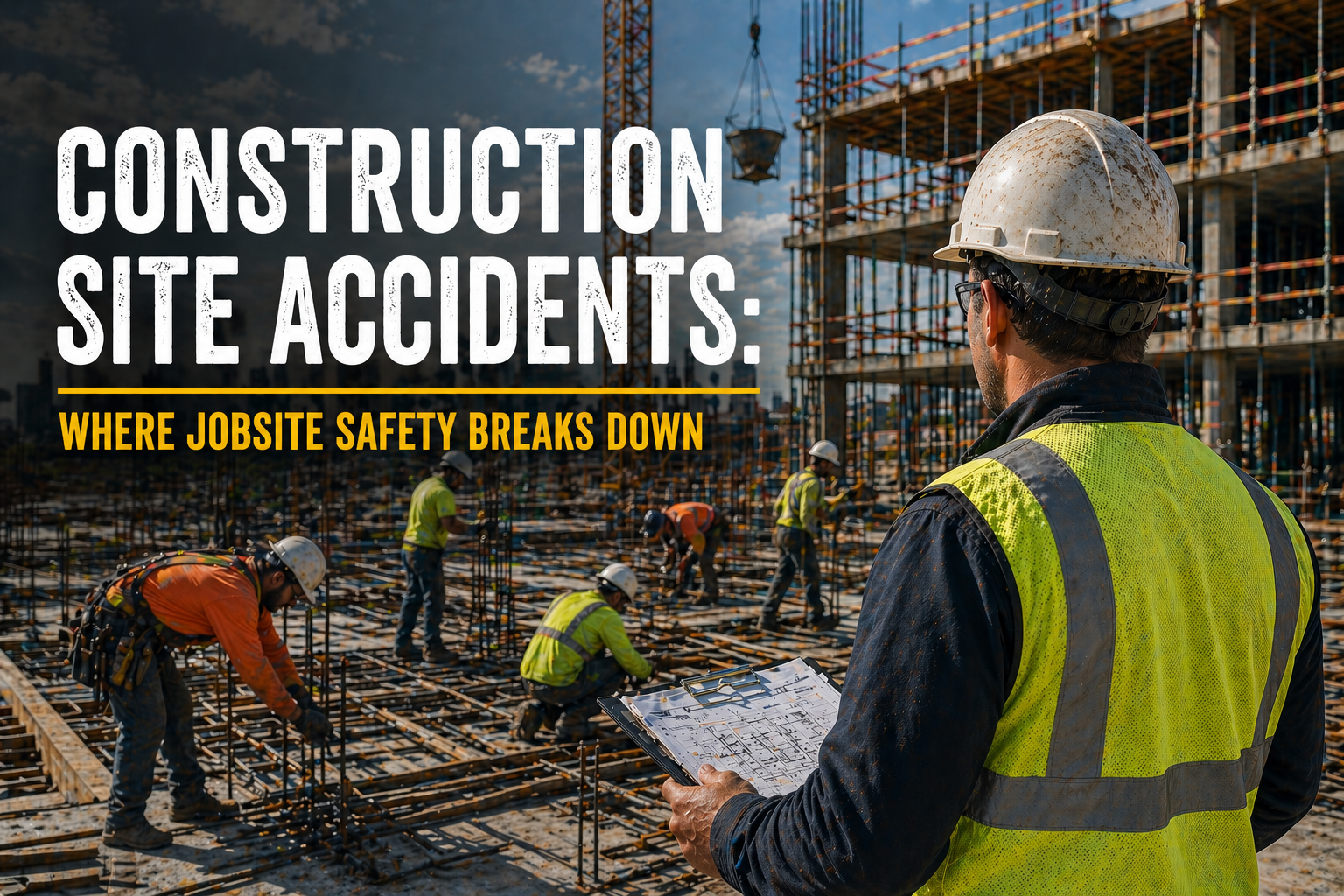
On most construction sites, you’ve got multiple teams working side by side under tight deadlines. With so much happening at once, risks are part of the job, but serious accidents usually don’t come out of nowhere.
In many cases, the same hazards show up again and again, usually linked to how the work is planned and managed on site. That’s where contractors make a real difference, because the way a job site is run has a direct impact on how safely it operates.
Safety Breakdowns Usually Start with Known Risks
Most construction site accidents come from risks that are already well understood. Of the 893 construction workers and supervisors who lost their lives on the job in 2024, 400 of those deaths were linked to falls, trips, and slips. These are part of everyday work on scaffolding, ladders, roofs, and unfinished structures, not rare or unpredictable hazards.
Everyone on site knows where falls can occur, but the same scenarios keep playing out. This usually comes down to how work is set up in the first place. When access points are rushed, fall protection is treated as optional, or conditions change without a proper reset, small gaps can lead to serious incidents.
Contractors decide how work is sequenced, access is managed, and how consistently safety measures are applied. When those decisions lean toward speed or convenience, familiar risks become harder to control, even when everyone on site understands them.
Why Familiar Risks Still Catch Crews Out
On most sites, the issue is how risks are handled as the day unfolds, not that people don’t understand those risks. Work moves, conditions change, and different crews cycle through the same areas. What felt controlled in the morning can look very different a few hours later.
It’s easy for assumptions to creep in. One crew may think an area is safe because it was set up earlier. Another may expect hazards to be flagged before they arrive. When a handover is not clear, gaps appear without anyone noticing straight away.
Routine also plays a part. Repetitive tasks can start to feel familiar, even when the exposure has not changed. Attention slips because the work feels predictable, not because people are careless.
This is where contractors come in, because they influence how well these moments are handled. When checks are part of the day, changes are communicated clearly, and crews are expected to reassess conditions as they go, familiar risks stay visible instead of being taken for granted.
The More Trades on Site, the Easier It Is to Lose Control
Coordination gets more difficult as more trades move onto a site. Electricians, roofers, and equipment operators may all be working close together, each at their own pace and with their own priorities. Work overlaps, access points change, and responsibilities can blur if they are not clearly defined.
This is where contractor oversight becomes critical. According to a 2025 report on Construction Industry Safety Challenges, 16% of respondents identified subcontractor management as a major challenge, even though 71% said that onboarding subcontractors with a clear compliance focus has a strong impact on safety outcomes. Everyone knows they need to be on the same page, but it does not always play out that way on site.
Risks also multiply when expectations vary between trades. One crew may follow strict fall protection protocols, while another takes a more relaxed approach. One team may communicate hazards clearly, while another assumes the area is understood. These differences are not always obvious at first, but they create gaps that widen as work progresses.
Contractors are the link between these groups. When onboarding, communication, and supervision are consistent across trades, the site operates as a coordinated system. When they are not, safety becomes fragmented, and each crew ends up working within its own version of the plan.
Where Safety Gets Treated as a Trade-Off
On many job sites, safety is not ignored, but it does get weighed against other pressures. Deadlines, budgets, and sequencing all impact how decisions are made from one stage of the job to the next.
This shows up in small choices. Work starts before everything is fully in place, a task moves ahead because stopping would slow the schedule, and setups get adjusted instead of reset. None of these decisions is unusual on its own, but they build over time.
This is where contractor priorities come into play. The way a job is managed influences what gets treated as essential and what gets worked around. When safety is seen as something that has to fit around the job, it becomes easier for gaps to open up.
On sites where things run well, those trade-offs are handled differently. Work is sequenced so that protection is in place before exposure begins. Crews are not expected to work around incomplete setups. The job is structured so that safety is part of how progress is made, not something that competes with it.
What Happens After an Accident Is Crucial Evidence
When a serious incident occurs, attention moves quickly from the job itself to how it was managed. Investigations may involve regulators, insurers, and construction accident lawyers all working to understand what happened and how responsibility is shared across the site.
At this stage, the decisions made on site are examined in detail. How the work was carried out, risks were handled, and what steps were taken at the time all come into focus. What may have felt routine during daily operations can carry more weight when reviewed in this context.
For contractors, this is where earlier choices are looked at more closely. Gaps that seemed manageable at the time can become far more visible when viewed through the lens of accountability.
What Better Job Site Safety Looks Like
Better job site safety comes down to how consistently the basics hold up from one crew to the next, rather than adding more rules on paper.
On sites where things run well, expectations are clear before work starts and remain consistent as the job progresses. Subcontractors arrive knowing how the site operates, not trying to figure it out as they go. When conditions change, those changes are picked up quickly rather than left to assumption.
Supervision is steady throughout the day, not just when something goes wrong. This consistency makes it easier for crews to follow the same standard, regardless of who is working in a given area.
You can see it in the smaller decisions. Access is set up properly, protection stays in place, and hazards are dealt with rather than worked around. These are not big changes, but they influence how the site runs as a whole.
When those day-to-day decisions hold up across the site, safety becomes part of the job itself. That is what separates sites that stay on top of risk from those that struggle with it.